The Story of Bauwerk Colour
About Us
Author
Andreas Riedel
Publisher
Bauwerk Colour
Published
14 Mai 2024
Last Revision
24. September 2026
About US, told by Bronwyn and Andreas Riedel, founders of Bauwerk Colour.
In the beginning...
...there were two people on opposite ends of the world. Both had one thing in common: ISOLATION. One lived on a remote farm in Australia with many miles of farmland to the nearest neighbour, the other lived on the communist side of Germany with every restriction in place of seeing the world or choosing his own destiny.
But isolation does have peculiar side effects: one sees the immediate world with greater intensity. The remote rural landscape of Australia, its colours and shapes, burned deep into the soul. The overgrown vineyards and buildings in Dresden, East Germany, and the sensual landscape and tactile, hand-hewn sandstone of decaying historic structures left a lifelong appreciation for textures and harmonious structures.
Both came together years later, after Andreas left East Germany and migrated to Australia to start a new life. Bronwyn moved from the remote Victorian farm to Melbourne and later Perth, Western Australia, where they finally met and fell in love with each other.
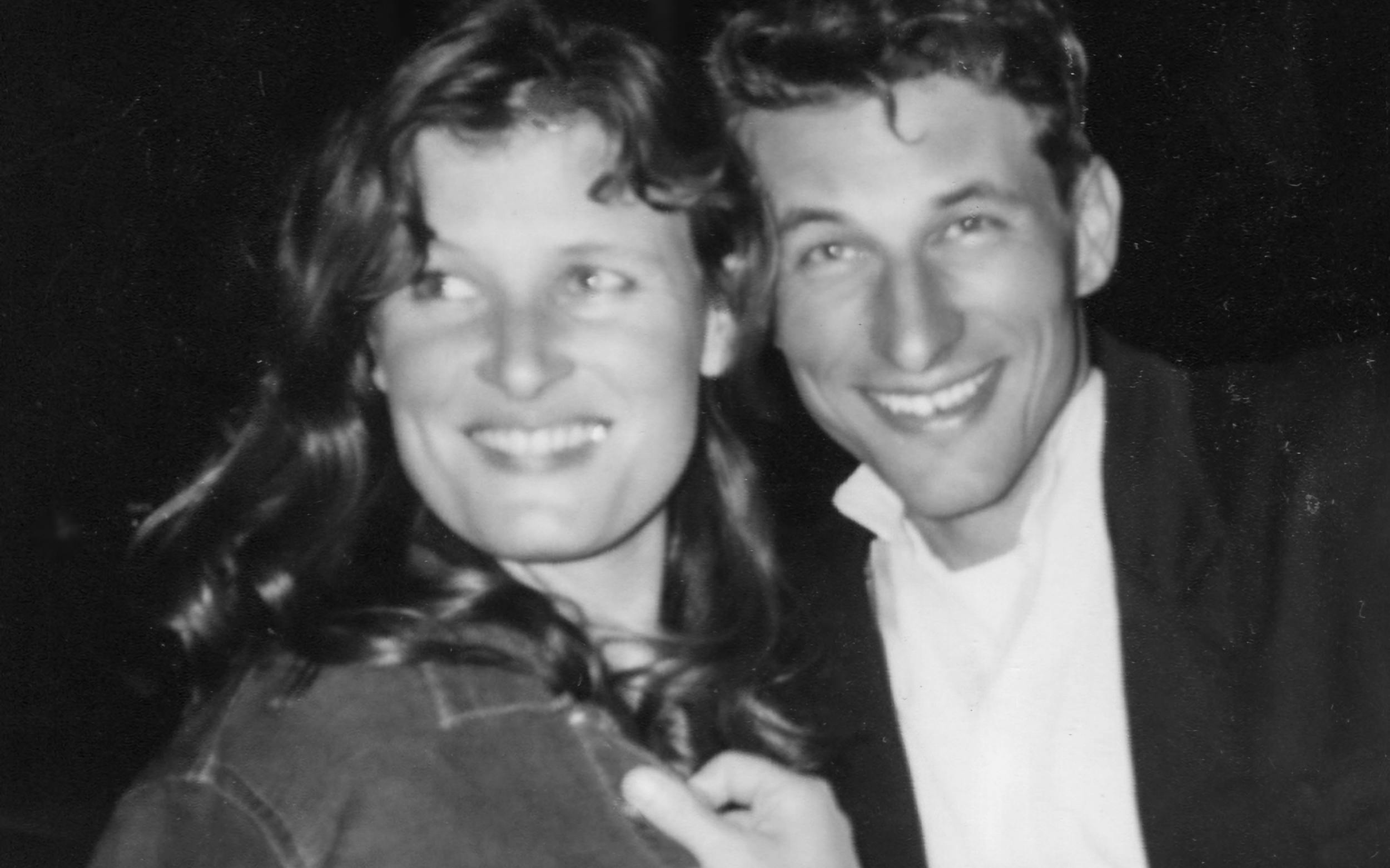
Andreas started a building company specialising in the conservation and restoration of historic buildings.
Bronwyn ran her own textile business, producing hand-painted fabrics and teaching colour theory.
Starting a paint company (2000)
Bauwerk did not begin as a “paint brand.” It began on building sites - in the restoration of old structures where time had already tested every material. Andreas saw it repeatedly: modern coatings failing, suffocating surfaces, peeling away. And underneath them, still intact, quietly doing their job - lime.
That was the first truth.
A work accident meant that Bronwyn needed to recover for several weeks and had time to ponder a future where Andreas and Bronwyn could combine their talents and work in a joint business.
Bronwyn's background in textiles and colour theory taught her that colour is never static. It shifts with light, with texture, with depth.
By then Andreas already supplied his own lime paints for the heritage projects he was contracted to do. His research had shown a remarkable resilience of limewash beneath all sorts of other paint layers on the buildings he worked on. All the paint layers from before the 1950s had survived, whereas more recent layers were peeling off and, because they were not breathable, were doing harm to the fabric of the buildings.
Bronwyn and Andreas found a property from where to start their paint business in South Fremantle, close to the harbour and only a few steps away from the Indian Ocean. The property was a former bakery with the old bakehouse out the back and a front showroom at street level. While Andreas and his building team were busy with an amazing project 1000 km north of Perth, Bronwyn set out to renovate the new-found shop.
Today the same area is a bustling shopping strip, but when Bauwerk moved into South Fremantle it had a sad and abandoned feeling. So the idea was born to combine the paint shop with a café. It would bring people to the area and make shopping for lime paints more of a destination and a discovery. A young team was hired to run the café. Bronwyn created the menu and Andreas the systems and technical side of the paint business.
Within a year the café won a Mietta Award, given to Australia's top cafés and restaurants. So it was proven that Bronwyn could come up with excellent recipes — something she also excelled at when creating colour recipes for Bauwerk Colour's lime paint range.
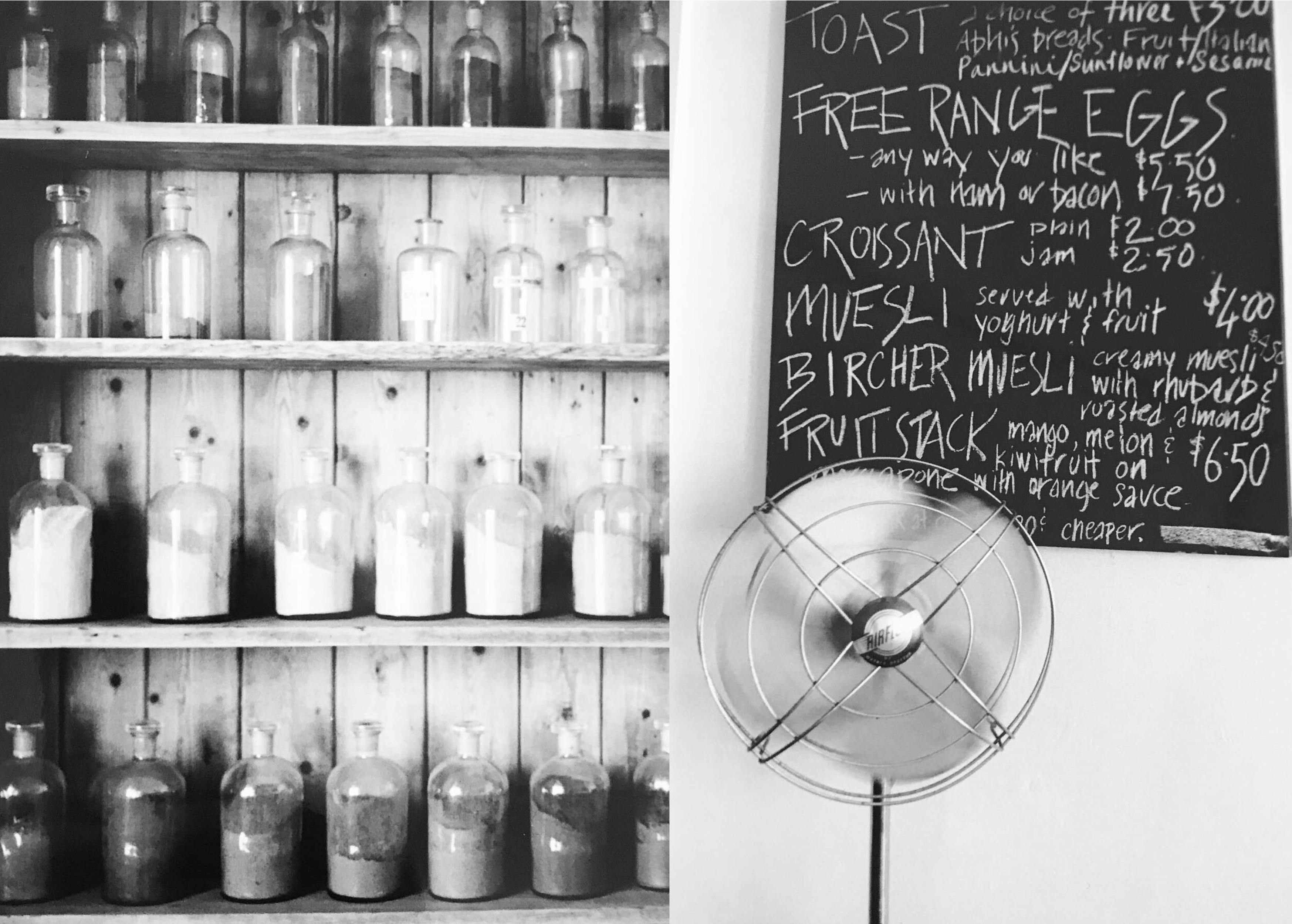
But limewash paint does require more than colour. We had an amazing resource close at hand: lime. A family who had come from Yugoslavia was still operating a traditional wood-fired lime kiln, producing exceptionally pure, white lime putty, which Andreas already used for restoration projects.
The lime putty required ageing. Like a good wine, it simply gets better the longer it is allowed to hydrate.
A lot of research went into the pigments that create the colour range Bauwerk offers today. Only powder pigments should be added, pure and simple. Their long-term stability under the intense Western Australian sun, in heat and in an alkaline medium were just some of the things we had to consider.
Nobody, it seemed, had taken the effort to elevate the humble whitewash, purify it, strengthen its inherent qualities and put it into a fresh, modern context. But when it was done carefully and applied with the right brush, nice and thin, the paint became more than a decoration. It became a more sensuous, dynamic and creative process. What's more, lime paint follows a full alchemist's cycle:
As a raw material, made from sea shells, it starts as a STONE. Chemically it is calcium carbonate.
It then gets heated with FIRE. During that process carbon dioxide is released into the atmosphere. Chemically it is then calcium oxide.
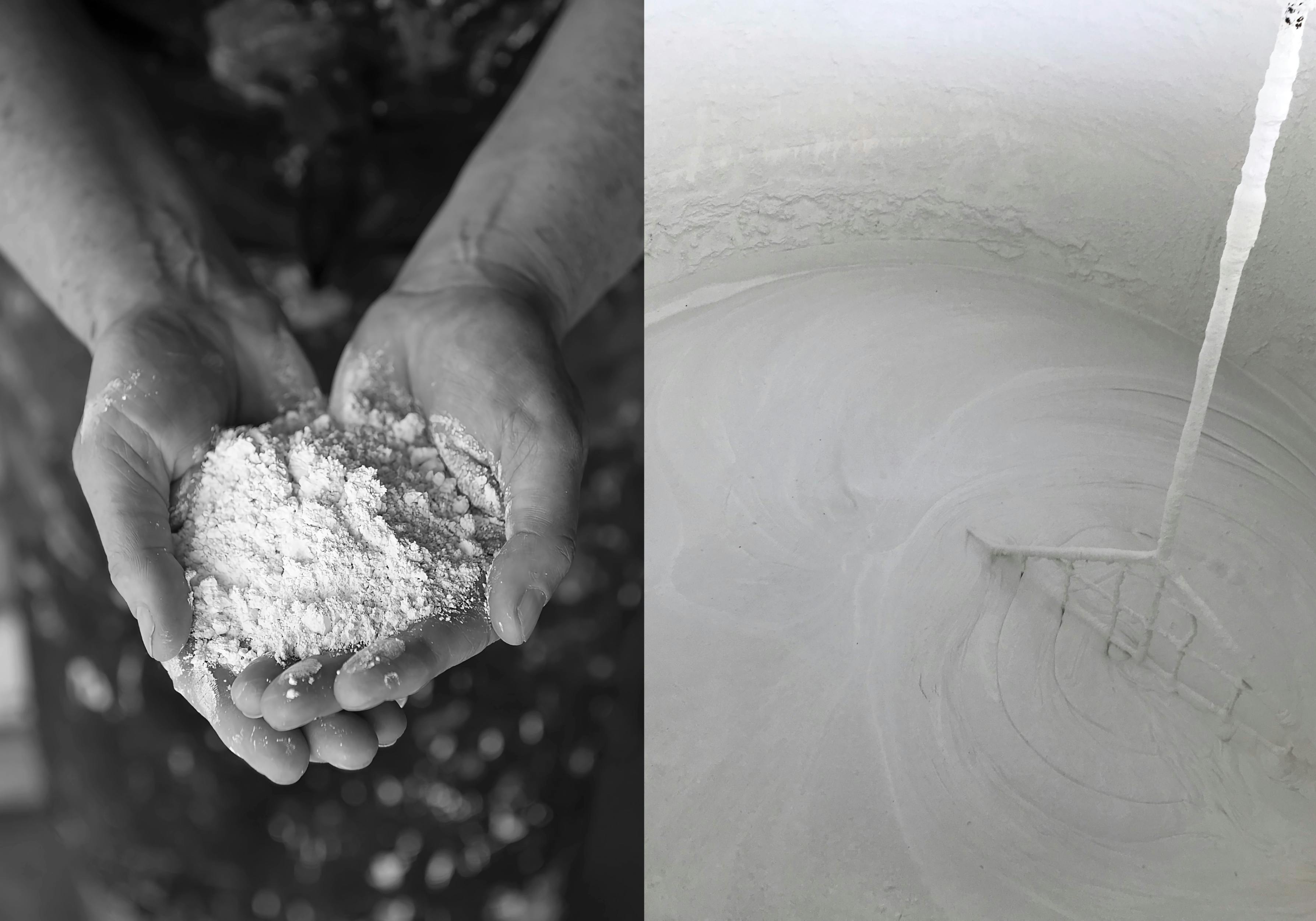
After cooling, the burnt lime is mixed with WATER. This transforms it into lime putty (calcium hydroxide).
The lime putty forms the basis of the paint. It is mixed, purified and, after long storage, brought to the right consistency. The pigments are added and the paint is shipped to where it is needed.
When it is finally painted on the wall, it takes up CO₂ from the AIR and gradually returns to calcium carbonate.
That return to stone is not merely a metaphor — it is chemistry. And it is also something more to us.
Applied thinly, by hand, limewash creates variation that cannot be replicated mechanically. Each wall carries subtle inconsistencies — and that is precisely where its character lies.
And there you have it: STONE — FIRE — WATER — AIR. Pure, perfect, seemingly simple. Natural. In other words: Bauwerk Colour!
Looking for growth (2005)
A good product needs a good home. For Bronwyn and Andreas, the ISOLATION of Western Australia provided a place to invent, experiment and perfect the product. But Western Australia is vast — about one third the size of Europe — and its potential customers were spread a long way apart. Most lived around Perth, with the next major Australian city, Adelaide, a long journey away.
For Bronwyn and Andreas, reaching larger markets was a necessity. Within Australia Melbourne was a good market, but a five-hour flight away. For a small company, setting up in other cities was costly.
If you need to travel by plane anyway, what other markets were available, they wondered? Their website was already attracting attention from the Middle East, so they decided to exhibit at the BIG5 building expo in Dubai.
Andreas and Bronwyn manned the booth. At only 1.5 metres wide, not much could be displayed. But a video loop showed one amazing image after another from projects completed in Australia. That was enough: a first project in Saudi Arabia was secured, followed by quite a number more. Some of the homes were on a different scale — some required two containers of paint — and it was clear there was potential.

Living Internationally (2008)
Be careful what you wish for. Growing beyond your home confines has many challenges. Living apart is one of them.
Andreas and Bronwyn had started their paint brand in the year they turned 40. They made a promise to dedicate the next 20 years of their lives to the venture and take it as far as they could. Their sons Levi and Thomas were finishing school, and it was the right time to start something new.
Andreas supported sales in the Middle East and realised that the materials used to render the houses were not ideal for applying their paint. He collected samples and researched better raw materials. Explaining the benefits of adding lime to renders and using different types of sand and cement convinced a Saudi customer to finish his building with the suggested render mix.
The result was something new, and the paint produced such a fascinating finish that a business partner approached Andreas about building a factory in Riyadh to produce such renders commercially.
It took some time to secure the industrial site and the first small-scale factory was set up. The goal was to produce sprayable renders, something that never had been attempted in the hot Middle Eastern Desert of Saudi Arabia. Nobody knew if it was even technically possible.
Machines were imported and adapted, trial after trial was run until the recipe was right.
Today, DMC, the company set up to produce the sprayable renders, is known in Saudi Arabia for its sophisticated range of dry mortar products. Sprayed render has since become common practice. DMC's range includes lime renders and a lime coat specially developed for Bauwerk Lime Paint.
During that time Levi, Bronwyn and Andreas's first son, started to work in the company — first helping out, then casually, and finally in a full-time position.
Meanwhile other paint projects took place in Qatar, Kuwait and Dubai and first sales in Europe.
Bronwyn and Andreas thought of ways to reach customers who lived far away and could not visit a physical store. The internet developed, websites became more sophisticated, and selling online became more possible and widespread. Bronwyn started the social media accounts. Instagram arrived, and with it a powerful way to share images.
Moving to Europe (2009)
Whilst holidaying in Europe, Bronwyn increasingly researched a place where the whole family could come together. What Bronwyn and Andreas settled on was an abandoned manor house deep in the North Saxon countryside. The description mentioned a former water castle with an enormous plane tree in the front garden. Both travelled to see the tree, since plane trees were something they had planted wherever they lived or built houses.
But sitting on the front steps of the old house and looking at the majestic tree, both knew they had found something special. It had been abandoned for more than 20 years and came without water, electricity, heating, internet or a functioning septic system. Restoring houses was not totally unfamiliar territory; the foundations and the bones of the building were sound. Everything else would have to come slowly

https://www.instagram.com/somewheresouthofberlin/
By then a first branch of Bauwerk Colour had started in the UK, soon to be followed in Holland. Fate would have it that both operators needed to make changes, and Bronwyn and Andreas decided it was time to set up office in Germany. Both were by then shuttling between Australia, the Middle East and Europe. That is fun for a while, especially when one can seek out the warmer months and skip long, cold winters.
However, try to grow veggies AND eat them while satisfying different tax authorities — it makes for a slightly more complicated life!
Setbacks call for a reset of focus (2017)
Setbacks can come out of the blue. The first was a dramatic change in Saudi Arabia's construction market. Building activity slowed sharply and companies scrambled to survive. DMC, the mortar company in Riyadh into which Andreas had put so much effort, was no exception. The company was in great difficulty, but thanks to its focus on quality and orders for the Riyadh Metro construction, it survived.
Andreas and Bronwyn decided it was time to focus on Europe and both moved into the manor house in Germany. Thankfully, by then they had put in place all the services and were completing a modern heating system.
It was time to improve the systems and packaging, hire more staff, buy adjacent properties as they came up for sale, and update the website to allow exports to European countries and North America. Brexit brought another challenge. The UK was Bauwerk Colour's strongest market in Europe and remains so. With persistence, a workable solution was found to make it easy for UK customers to receive their orders.
And then Covid started. Nobody knew how to sail through a pandemic. But people stuck at home were getting sick of having nothing to do — except renovate! BAUWERK's focus on online sales turned out to be a hell of an advantage. Growth went berserk! We hired more staff, expanded into newly acquired buildings that needed serious renovation, and shuffled stock to and from Australia to make up for shortages of some raw materials.
Keeping up with the times and listening to customers — without wavering from the principles of sustainability.
Amazingly, by then both sons of Andreas and Bronwyn worked firmly in the business. Levi manages Australia; Thomas now lives in Germany and manages part of the team here. And with that, all together, we are...
On the path to sustainable growth (2023)
2023 saw the introduction of a much needed new website. A lot of time went into its design and functionality. A great team from Melbourne set about bringing our ideas to life and creating what we hoped would be the most advanced online store experience for limewash paints. It really is a crazy task. Millions of data points must be accurate for it to work. Tax rules for dozens of jurisdictions have to be taken into account; everything must integrate with shipping companies; and, last but not least (!), every transaction must be recorded accurately under Germany's stringent tax regulations. Pfffft!!!
With several thousand orders each month, Bronwyn and Andreas set out one guiding principle: strong growth must be sustainable. That means building a great team who can process and fulfil orders without unnecessary stress, while never compromising the quality of customer service. It also means financial prudence. Bauwerk has never taken on debt; both founders believe in growing with funds generated by the business itself.
Growth with real products also needs physical space. A few years ago Andreas and Bronwyn had the opportunity to purchase two great barns next to the old manor house. They had once belonged to the estate. Built in successive years, starting in 1735, they had seen little maintenance or improvement since.
Andreas's experience with historic buildings helped realise their transformation from horse and sheep stables into spaces for making and processing paint. We kept the time-worn beams, stone walls and remarkable roof construction. The barns are full of life again and, amazingly, have limewashed walls again too. Work has now started on new extensions for the next phase. Reusing neglected historic buildings is part of sustainability for us. It also keeps workplaces within the village.
Our Village (2024)
Our village, by the way, has just 115 inhabitants. But together we punch well above our size. We entered Unser Dorf hat Zukunft — 'Our Village Has a Future' — at district level and won! The recognition was not about how pretty the village is. It was about what our community offers children, families and older generations, and the part local businesses play in village life. The village went on to receive a special prize at state level for its work with children and young people on the environment.
It also gave us reason to celebrate how warmly we were welcomed here, and how much a part of this little community we have become. When people can live and work in a rural place like this, sustainability is lived every day.
But why stop there? We wanted to take steps towards greater energy self-sufficiency. We are working on a solar installation of around 32 kWp. Because this is a historic estate, its appearance matters too. Rather than put panels on the old roofs, we want the installation to have its own useful form, set away from the historic buildings.
We have planted more trees, replacing fruit trees from the old orchard that have not survived the dry summers. We have added another plane tree which, in time, will shade the yard in front of the barns.
Tom took it upon himself to install owl boxes and place them carefully in mature trees. He has written about it in his own article, which we hope to publish soon.
And there are plenty more ideas. Andreas is working on plans to use water stored in the vast cellars beneath the manor house to help heat it. Together with a water-to-water heat pump, the system could use surplus solar power to store heat for colder days. The aim is to reduce our use of natural gas and keep it as a backup for unusually long cold spells.
Where from here? (2026)
What stays?
We think of our colours as recipes, not formulas.
They are built carefully, tested rigorously, and then released knowing they will continue to evolve once applied. The wall, the light, the hand of the applicator — all become part of the final result. Control is not the goal. Harmony is.
This is why Bauwerk has always sat slightly outside the conventional paint industry.
We are not interested in uniformity. We are interested in permanence, tactility, and atmosphere. In surfaces that feel as though they belong to a place, rather than being imposed upon it.
Isolation gave us the space to develop that philosophy without compromise. Heritage buildings gave us the evidence. And the material itself continues to guide us.
Living and working among buildings that were here long before us has also changed how we think about our own place in the story. We look after them for a while, make them useful again, and eventually hand them on. The same is true, in a different way, of Bauwerk. We cannot know what the next generation will want to do with it. We can try to leave them a sound business, good people around it, and the freedom to make choices of their own.
Everything else — the growth, the projects, the expansion into new regions — has followed from that core.
We are still, at heart, working with the same elements.
Stone. Fire. Water. Air.
Simple, ancient, and remarkably difficult to improve upon.
What changes?
We keep finding better ways to communicate with the wider world. Our team has grown, and with it the possibilities of what we can do together. We never tire of bringing remarkable projects and their creators together. We are inspired by the ways people use limewash in their own rooms. And yes, we agonise over colour choices in our own home too. It reminds us how much help a little good advice can be when someone is choosing colours for theirs.
Then there is AI. We are as challenged by it as everyone else. It raises questions about what is real, whose work we are seeing, and what happens to human creativity when a machine can produce an image or a piece of writing in seconds. We do not have a neat answer to all of that.
But we have found parts of it that help us. It can help us explore ideas, organise what we know and make that knowledge easier to share. It can give our photographers another way to imagine spaces that do not yet exist. We say when an image is imagined. And we remain responsible for what we publish. Colours are still created by people; real projects still matter; judgement still belongs to the people doing the work. If these tools can give us more time and room for that work, we want to use them well.
Sounds as though we are always busy? So how do we relax?
Spending time with family is hard to beat. We go for bike rides too. From here we can follow the river, cross the fields, take a path through the forest or ride into one of the surrounding towns and villages. We play cards with friends, or have dinner together.
Andreas sometimes picks up a paintbrush. After all the thinking about limewash, there is still the simple pleasure of putting it on a wall and watching what happens. Bronwyn disappears into her garden, where there is always something to tend to — or simply enjoy.
We are also excited about a whole set of new products taking shape. But that is for
another chapter in our story.....
Thank you for reading our story.
You might also be interested in: